
The short answer: grapes are sensitive to juglone, the toxic compound produced by black walnut trees, and planting them too close is a reliable way to end up with stunted, yellowing vines that never really take off. That said, 'too close' has a specific meaning, and with the right distance and a few soil strategies, growing grapes near black walnut is sometimes workable. Let me walk you through exactly what's happening, what to expect, and how to decide whether your situation is manageable or whether you need to find a different spot.
Can Grapes Grow Near Black Walnut Trees? Practical Tips

Marcus Whitfield
24 Mar 2026
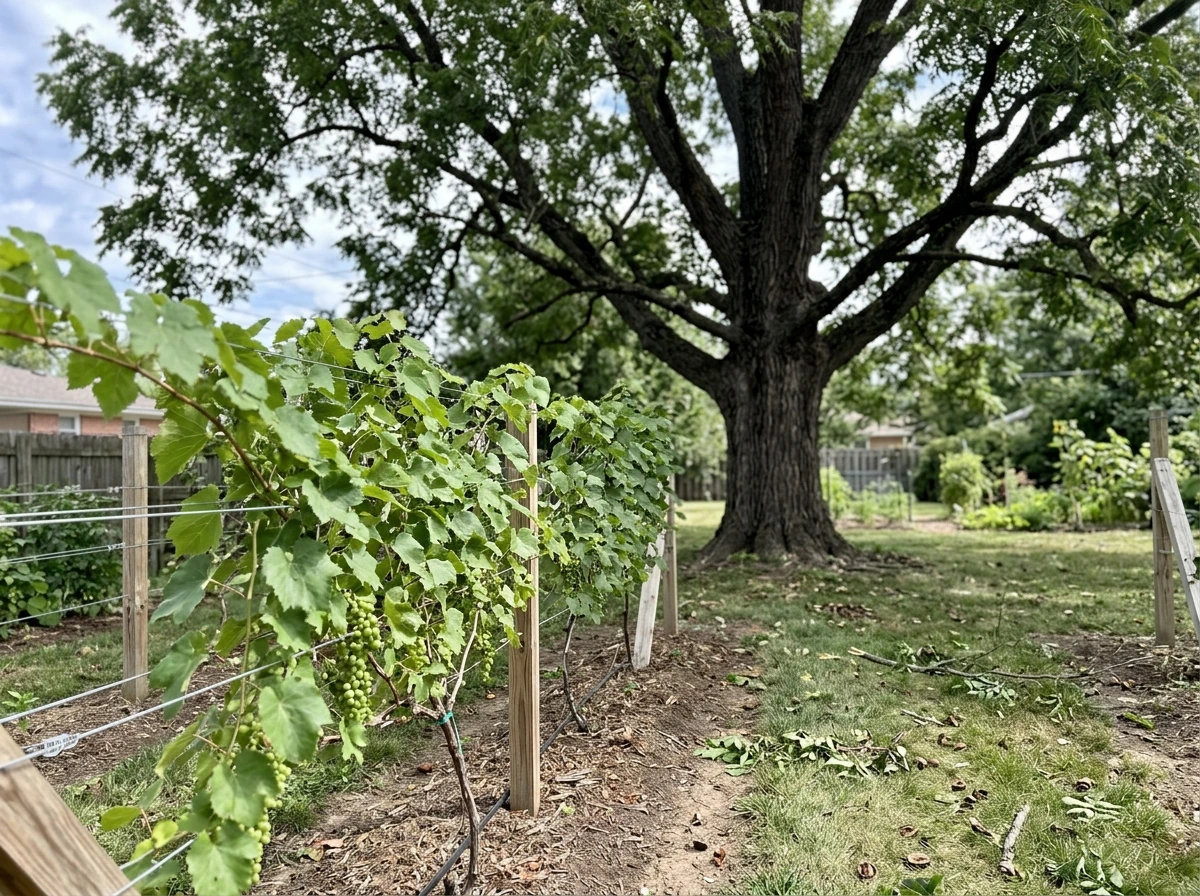
What juglone actually does to nearby plants
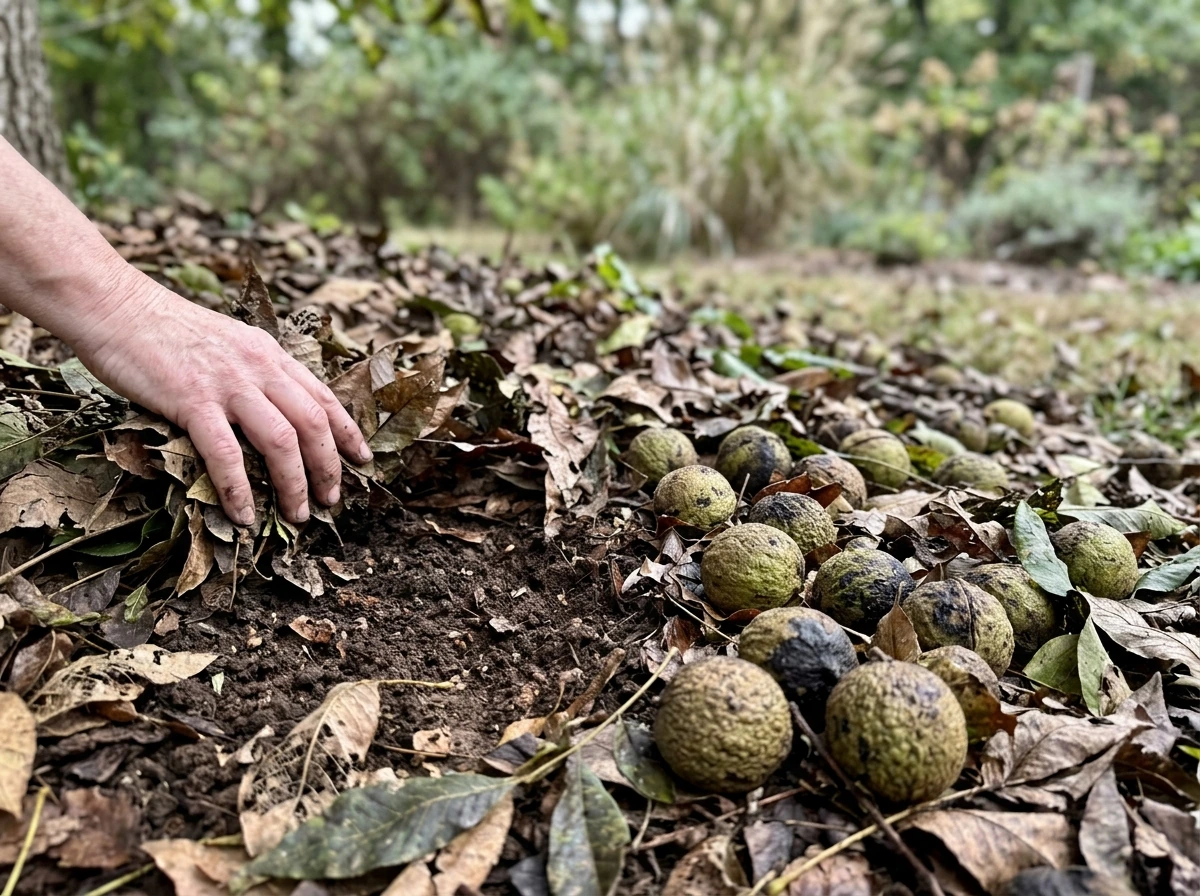
Black walnut (Juglans nigra) produces a compound called juglone in its leaves, roots, hulls, fruit, and bark. In its raw form inside the tree, it exists as a relatively harmless precursor called hydrojuglone glucoside. The problem starts when that compound gets exposed to air, water, or soil and oxidizes into biologically active juglone. Once active, it messes with how sensitive plants function at a cellular level: it reduces photosynthesis, suppresses respiration and transpiration, and limits stomatal conductance (basically how well leaves exchange gases). The result looks like a plant that's slowly suffocating even when it has water and nutrients.
Juglone concentrations vary a lot by season, tissue type, and how it moves through soil. Research shows it can range widely in plant tissues, and the rhizosphere (the zone right around walnut roots) typically has much higher concentrations than soil further away. The good news is that juglone doesn't persist forever. Studies show it has a half-life of roughly 2 to 14 days depending on soil pH, organic matter, and microbial activity, and it's rapidly broken down by soil bacteria in biologically active soils. The bad news: those roots keep producing it continuously, so the exposure never really stops as long as the tree is there and its roots reach your vines.
One thing worth knowing: if you cut the walnut tree down, the problem doesn't disappear immediately. Decomposing walnut roots continue releasing juglone for years afterward. So 'just remove the tree' isn't a quick fix if you've already got existing root mass in the ground.
What actually happens when grapes grow near black walnut
Grapes are listed among the sensitive plants when it comes to juglone exposure. University of Kentucky outreach specifically calls out grapes as susceptible, describing symptoms like yellowing leaves and wilting. In practical terms, what you're likely to see in a vine planted too close to a walnut is poor vigor from the start: slow establishment, pale or yellowing foliage, leaf curl or wilt even when the soil isn't dry, and overall stunted growth. The vine might hang on for a season or two but never really thrives. In worse cases, especially in wet or poorly aerated soils, it simply dies.
That said, grapes aren't at the extreme end of sensitivity the way tomatoes or rhododendrons are. Some home gardeners report vines surviving at distances that borderline the safe zone, especially in well-drained soils with healthy microbial activity that breaks juglone down faster. But 'surviving' and 'producing a good crop' are two very different things. For a productive home vineyard, you want vines that aren't fighting a chemical battle underground.
How far away is far enough
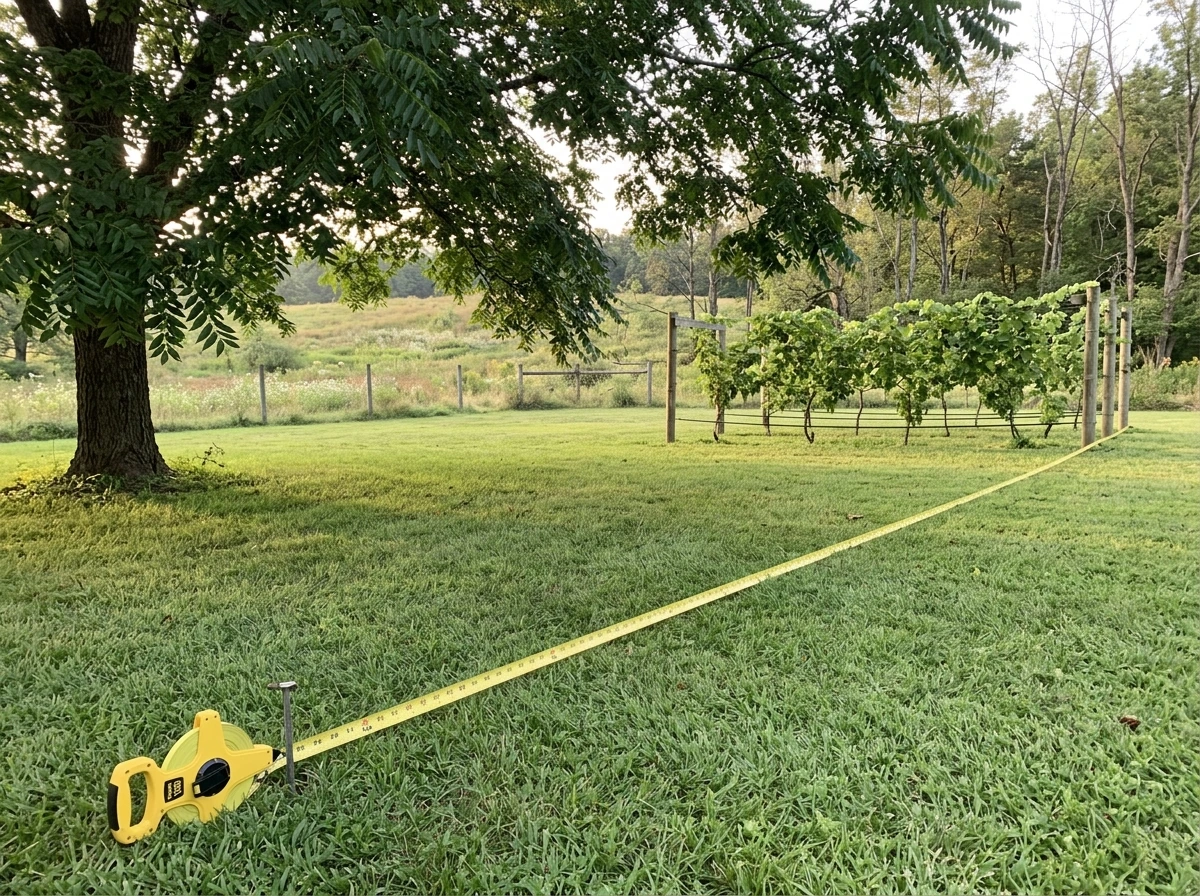
This is the question most home gardeners want answered, and the guidance from multiple extension programs converges pretty clearly. The toxic root zone of a large, mature black walnut averages 50 to 60 feet from the trunk, but plants as far as 80 feet away have been reported as injured. The drip line (the outer edge of the canopy) is often cited as a minimum reference point, but roots typically extend well beyond it.
The most grape-specific guidance I've found comes from Virginia Tech's viticulture notes, which give a practical rule of thumb: keep vines at least as far from the walnut's base as the walnut is tall. So if you've got a walnut that's 60 feet tall, keep your vines at least 60 feet away from its trunk. That aligns well with the 50 to 80 foot range cited by Morton Arboretum, Cornell, and Wisconsin Extension.
- Minimum safe distance: 50 feet from the trunk for sensitive plants, per multiple extension programs
- Practical target for grape vines: at least equal to the walnut's height from its base (Virginia Tech viticulture guidance)
- Injury has been observed at up to 80 feet from a mature tree, especially in favorable juglone-movement conditions
- The drip line is a useful visual reference but NOT a safe planting boundary on its own — roots extend further
- Butternut (Juglans cinerea) also produces juglone; apply the same distance rules if you have one nearby
If your available planting space puts you inside that range, don't give up yet. The next section covers how to manage the soil environment to reduce risk, though I want to be honest: the further inside the root zone you are, the harder these strategies become.
Managing soil and root zones to reduce juglone risk
If you can't get 50 to 60 feet of separation, physical and soil management strategies can lower the risk, though none of them are a guaranteed fix. Think of them as ways to reduce exposure and improve the soil environment so that whatever juglone does reach your vines is degraded faster and causes less damage.
Raised beds with root barriers
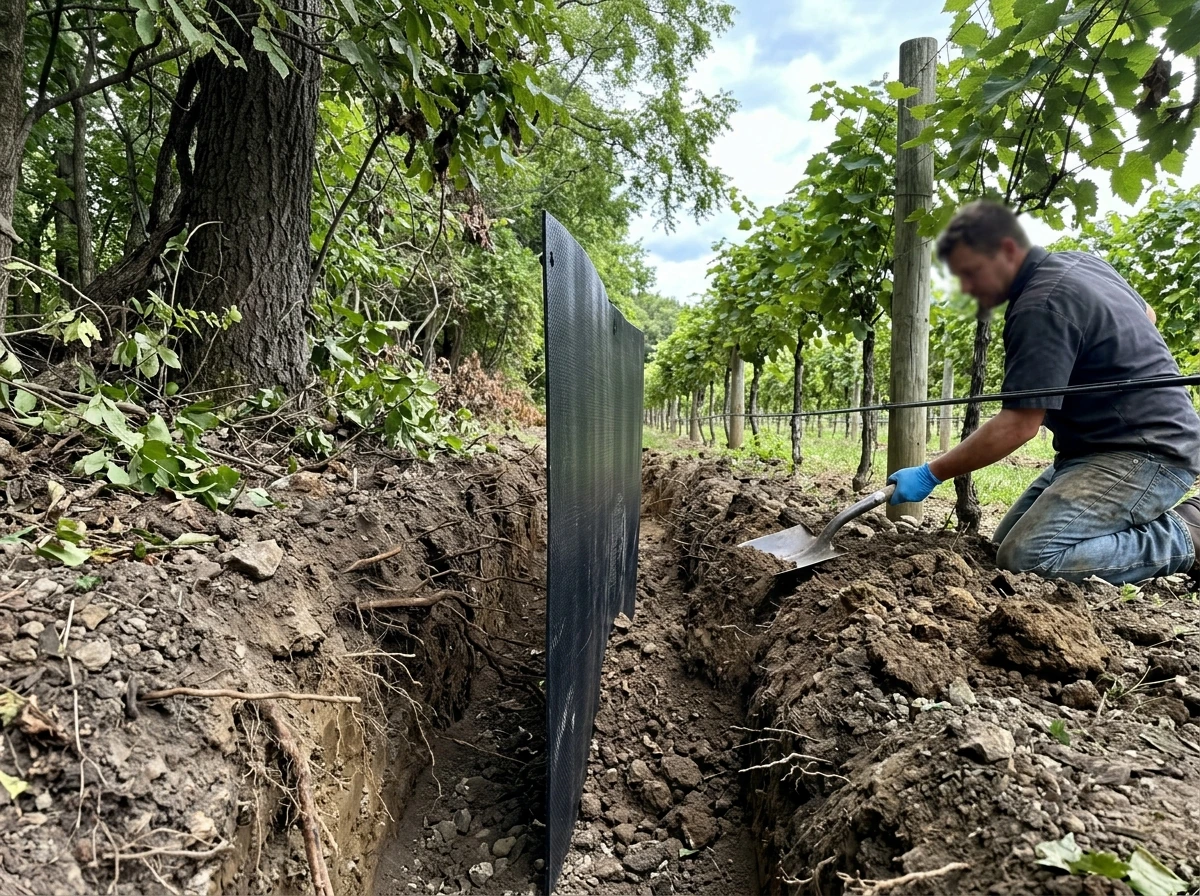
This is the most consistently recommended approach by extension programs, including Michigan State University Extension, which specifically recommends raised beds with physical barriers to prevent walnut roots from entering the bed area. The idea is straightforward: build a raised bed, line the bottom and sides with a physical root barrier (heavy-duty landscape fabric or a solid barrier material like a thick rubber liner), fill it with fresh, clean imported soil, and plant your vines there. This keeps walnut roots out and gives your vines a juglone-free root environment. The catch is that raised beds work better for shorter-season crops than for established grape vines, which develop extensive root systems over years. A grape vine's roots will eventually try to escape the bed, which is why the barrier needs to be deep, ideally 24 to 36 inches, and the bed sized generously.
Physical root barriers in the ground
For in-ground plantings that are near but not directly under walnut trees, installing a vertical root barrier between the walnut root zone and your grape row can slow walnut root intrusion. These barriers are typically installed 18 to 24 inches deep, though walnut roots can go deeper in loose soils. This approach is most practical if you have a clear boundary between your planting area and the walnut's direction, and less practical if the walnut is all around you.
Fresh, biologically active soil
Even without a full raised bed, improving soil biology in the planting area can help. Juglone breaks down much faster in soils with high microbial activity and good organic matter content. Penn State Extension specifically notes that poorly aerated, wet soils with limited microbial activity are where juglone damage is worst. Building your soil with compost, ensuring good drainage, and avoiding compaction all work in your favor. This won't eliminate juglone exposure, but it can shorten how long the compound remains active before soil bacteria break it down.
Keep walnut debris out of the grape area
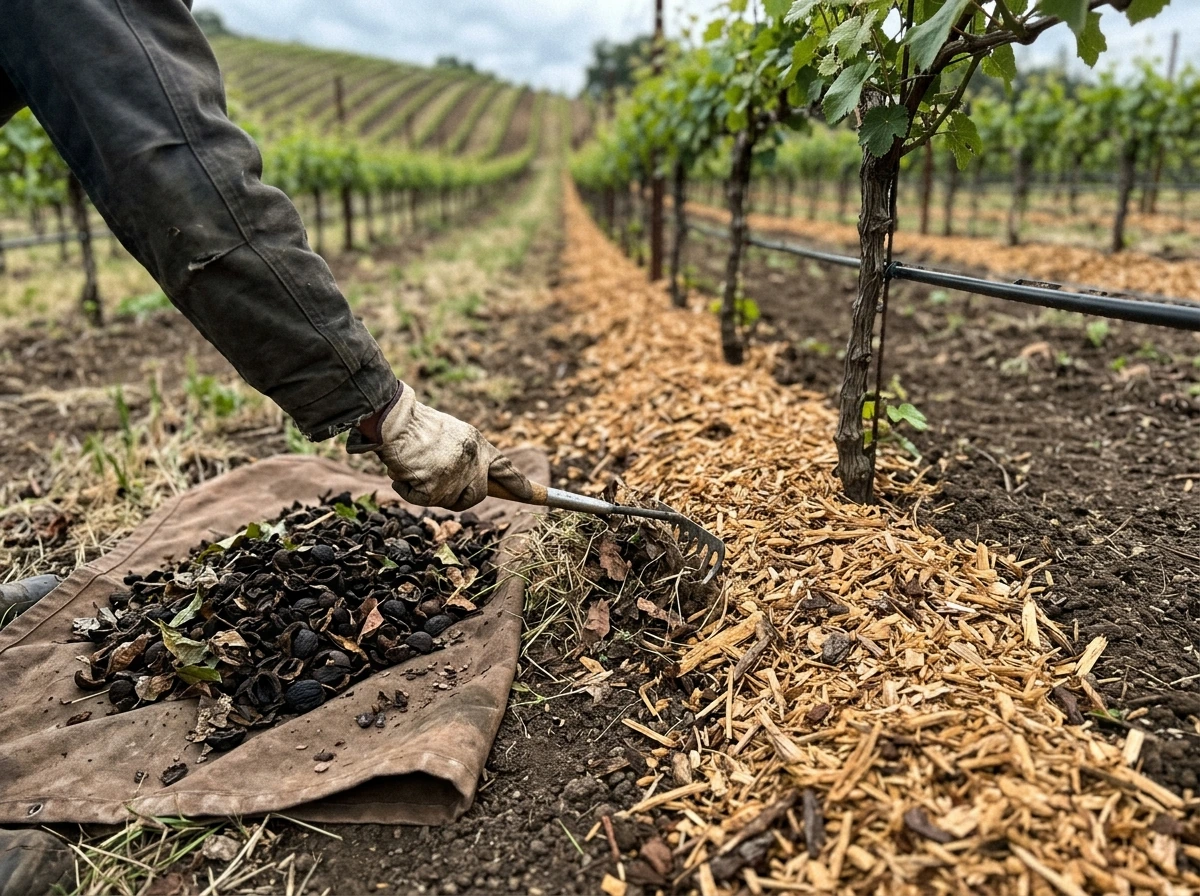
Walnut leaves, hulls, and nuts are all juglone sources. Don't mulch your grape rows with walnut leaf litter, don't let hulls accumulate near your vines, and if you're downhill or downwind from the tree, think about how debris moves across your property after wind events. Penn State Extension notes that direct accumulation of leaf and hull material is a primary exposure route alongside root contact.
A practical trial plan for home gardeners
If you're not sure whether your specific site is problematic, a small trial planting is the most honest way to find out before committing to a full vineyard setup. Here's a simple approach that will give you useful data within one growing season.
- Plant two or three vines in the area you're considering, using a vigorous, hardy variety (more on variety selection below). Keep detailed notes on where exactly they're positioned relative to the walnut.
- Also plant one or two vines of the same variety in a spot you know is clear of walnut influence, ideally at least 80 feet away or on a completely different part of your property. This is your control.
- Over the growing season, monitor leaf color (yellowing or pale green is a warning sign), shoot vigor (how much new growth are you getting compared to the control?), and overall plant health at the end of the season.
- If your trial vines near the walnut show significantly less vigor, yellowing, wilting without drought stress, or poor root establishment when you check them at the end of the season, that's your data point: the site is problematic.
- Decision point at end of season one: if the trial vines are performing within 20 to 30% of the control vines, the site may be workable with soil management. If they're dramatically weaker or showing classic juglone symptoms, move the vineyard location.
- If you go ahead with the site, implement the raised bed or root barrier strategy before expanding. Don't scale up until you've proven the trial vines can establish well.
One season isn't always enough to see the full picture, especially since juglone symptoms can worsen as walnut roots extend further into your planting area over multiple years. If you're not sure whether your specific site is problematic, a small trial planting is the most honest way to find out before committing to a full vineyard setup. Here's a simple approach that will give you useful data within one growing season. Some home gardeners report slow degradation in vine health over a three to five year window as walnut roots catch up with established vines.
How your region and climate change the picture
Where you live affects both how severe the juglone problem is likely to be and which grape varieties are realistic options. These two things interact more than most gardeners realize.
Wet climates and poorly drained soils
If you're in a wetter region, like the upper Midwest, the Pacific Northwest, or the mid-Atlantic states, poorly drained soils are a serious amplifier. Juglone toxicity is worst in saturated, low-oxygen conditions where microbial activity slows and juglone lingers longer before breaking down. If you've got a walnut near a low-lying area or clay-heavy soil, the risk to your vines is meaningfully higher than the same distance in a well-drained sandy loam. In these regions, the raised bed approach with good drainage becomes even more critical if you're anywhere near the walnut's root zone.
Drier climates and sandy soils
In drier regions like the Southwest, the Great Plains, or parts of the South, well-drained sandy or loamy soils with active microbial communities tend to break down juglone more quickly. Research confirms that juglone has a half-life as short as two days in ideal microbial conditions. In these soils, vines planted near the outer edge of the 50 to 80 foot zone may fare reasonably well. That said, water movement matters too: in irrigated situations where water is moving through the soil regularly, juglone can travel further from its source than in dry conditions where it tends to stay concentrated near the roots.
Growing season length and vine establishment
In northern states with short growing seasons (zones 4 to 5), vines already face pressure from late frosts and short warmth windows. Adding juglone stress to an already challenged vine in a cool climate is a compounding problem. If you're in zone 4 in Minnesota or upstate New York, I'd be much more conservative about proximity than if you're in zone 7 in Virginia with a long, warm season that lets vines establish quickly and vigorously.
Grape variety selection by region
Regardless of the walnut situation, your grape variety needs to match your climate zone. American and hybrid varieties like Concord, Niagara, Marquette, and Frontenac are better suited to colder northern zones and tend to be more vigorous and resilient overall. Vinifera varieties like Cabernet Sauvignon and Pinot Noir are more delicate and already harder to establish in marginal climates, so adding juglone stress on top of climate stress makes them particularly poor candidates near black walnut. If you're in a borderline-proximity situation, lean hard toward the most vigorous hybrid varieties for your zone. Vigor is your buffer.
Black walnut vs. other Juglans trees: a quick comparison
Not all walnut-family trees pose the same risk. Here's how the main ones compare so you know what you're actually dealing with.
| Tree | Juglone Level | Practical Risk to Grapes | Recommended Separation |
|---|---|---|---|
| Black walnut (Juglans nigra) | Highest | High — grapes are listed as sensitive | 50–80 ft minimum; use walnut height as guide |
| Butternut (Juglans cinerea) | Moderate | Moderate — apply similar caution | 50 ft minimum recommended |
| English/Persian walnut (Juglans regia) | Lower than black walnut | Lower but not zero | Apply reasonable separation, 30–50 ft |
| Hickory, pecan (Carya species) | Very low / negligible | Minimal documented risk | No specific spacing required |
What to do if black walnut is a hard no for your site
Sometimes the honest answer is that the spot you want to plant just isn't going to work for grapes because of walnut proximity. Maybe you can't get 60 feet of separation, you've already done a trial and the vines are struggling, or your soil conditions make juglone impact worse. Here's how to move forward productively instead of fighting a losing battle.
Find a different site on your property
This is almost always the best option if it's physically possible. Grapes are flexible about a lot of things: they grow on vines that can be trained along a fence, a trellis on the edge of a driveway, or even up a pergola close to the house. You don't need a traditional vineyard row setup. A spot that's 60 or more feet from the walnut, gets 6 to 8 hours of sun, and has decent drainage can support great vines. Even a raised bed on a patio or near a different part of the yard, completely away from walnut root influence, is a legitimate vineyard setup for a home gardener.
Choose the most vigorous variety for your zone
If you're committed to trying the near-walnut site with barriers and raised beds, your best shot is with the most naturally vigorous grape variety that's suited to your climate. Vigorous vines produce more root mass and can sometimes compensate for stress that would knock out a weaker variety. In zone 5 and colder, that points toward American hybrids like Concord, Marquette, Frontenac Gris, or La Crescent. In zone 6 to 7, you have more options, including some French-American hybrids like Chambourcin or Seyval Blanc. In zones 7 and warmer, Muscadine grapes (Vitis rotundifolia) are notably vigorous and heat-tolerant, though they have their own specific care requirements.
Container growing as a workaround
For very small-scale situations, large containers (25 to 30 gallon minimum) filled with fresh potting mix are completely outside the juglone equation. Container-grown grapes won't produce like an in-ground vine, but they'll grow, produce some fruit, and give you the experience of growing grapes without the walnut problem. Position the containers away from the walnut and definitely don't use walnut leaf mulch or compost near them.
Improve the soil and wait after walnut removal
If you've removed or are planning to remove a black walnut tree, be patient. The decomposing root system continues to release juglone for years. Building soil organic matter and microbial activity in the former root zone over time is the best way to accelerate natural juglone degradation, but there's no shortcut to an instant safe planting zone. Give it at least a few years and do a trial planting before committing a full vineyard to that spot.
Growing grapes successfully is all about stacking favorable conditions, and proximity to black walnut is one of the cleaner problems to either solve or route around. Get the distance right, manage the soil environment, pick a variety matched to your climate zone, and you've handled the hardest part. If you're earlier in your grape-growing journey and still figuring out whether grapes will even work in your state or what growth habits to expect from your vines, it's worth reading up on how grapes grow and what supports they need before committing to a site, walnut tree or not. do grapes grow on trees. do grapes grow on new or old wood
FAQ
My vines are yellowing, should I assume it is juglone or a watering problem?
If you see yellowing, leaf curl, or wilting in the first season, check whether the issue lines up with walnut root proximity and avoid overcorrecting with extra fertilizer or irrigation. Juglone stress often appears even when soil moisture is adequate, so prioritize improving drainage, adding organic matter, and confirming your distance to the trunk and drip line.
How should I run a trial planting to know if the walnut site will work?
A trial planting should be in the same exact location you plan to use long term, not a nearby “buffer” spot. Use multiple young vines (at least 2 to 3), plant them the same day, and record leaf color, growth rate, and time to budbreak at 2 to 3 week intervals so you can tell slow decline from normal early-season variation.
Can I protect my grapes by mulching with leaves from the black walnut tree?
Mulch strategy matters. Do not use walnut leaves, hulls, or “leafy” compost made from walnut debris anywhere near the grape row, and keep a clean zone around the vine base. Even if you solved root contact, direct debris can create localized juglone exposure.
Will a root barrier guarantee my grapes will avoid juglone?
Yes, but only if the barriers actually prevent root entry and maintain clean rooting conditions over time. If a barrier is too shallow or gets pierced, walnut roots can bridge around it, and the vine may still contact juglone later, often after a year or two.
What makes raised-bed protection succeed or fail over the long term?
Raised beds help most when you use imported, clean soil and build to sufficient depth (often 24 to 36 inches) so grape roots cannot easily reach outside the bed. Also plan for ongoing soil movement, because settling can expose more of the sidewall and create gaps for roots.
Does slope or drainage direction change how bad the walnut effect will be?
Juglone risk can be worse when the site is downhill or where water collects, because moisture can keep conditions favorable for juglone to persist longer and can concentrate debris. If you can, map runoff paths and plant on the higher, better-drained side away from where leaf and hull material tends to collect.
If I use containers, do I still need to worry about walnut leaves blowing in?
Container grapes reduce root-contact risk, but not necessarily debris risk. Use large containers (the article notes 25 to 30 gallons minimum), keep them clearly separated from the walnut, and do not place walnut litter or yard waste in the container area where it can wash or blow into the pot.
Why do some gardeners get different results even at similar reported distances?
Planting distance rules of thumb can be misleading if the walnut’s canopy overhang suggests more root reach than you expect. Measure from the trunk and also consider how close the vine would be to the outer edge of the canopy over time, since walnuts keep expanding roots while grapes are still establishing.
What should I do if my grapes are already planted near the walnut?
If you already planted and the vine is struggling, switching to a weaker crop of grapes is usually not the fix. Consider relocating the grape row farther away, upgrading soil drainage, and switching to more vigorous varieties only if the site is marginal but not hopeless.
After removing the black walnut, how long should I wait before planting grapes in that spot?
Once the walnut is cut down, root release can continue for years, so “stump removal” does not create an instant safe zone. If you plan to replant in the same area, combine time with soil improvement (microbial activity, organic matter) and still run a trial planting before committing to a full vineyard.